The digital landscape in the United Kingdom has undergone a massive transformation in recent years, particularly in how businesses and platforms verify the identities of their users. Whether you are navigating the fintech sector, signing up for a new digital banking app, or exploring the vibrant online casino market, you will inevitably encounter different approaches to identity verification. Two of the most prominent, yet diametrically opposed, models are eKYC (Electronic Know Your Customer) and “No ID” (or No KYC) systems.
For UK operators and players alike, understanding the distinction between these two models is no longer just a matter of convenience—it is a critical aspect of security, legal compliance, and user experience. In 2026, as the UK Gambling Commission (UKGC) introduces even stricter regulatory frameworks, the divide between highly regulated eKYC platforms and offshore No ID casinos has never been wider.
This comprehensive guide explores the definitions, underlying technologies, core differences, and the regulatory realities of No ID and eKYC platforms in the UK market.
What is eKYC?
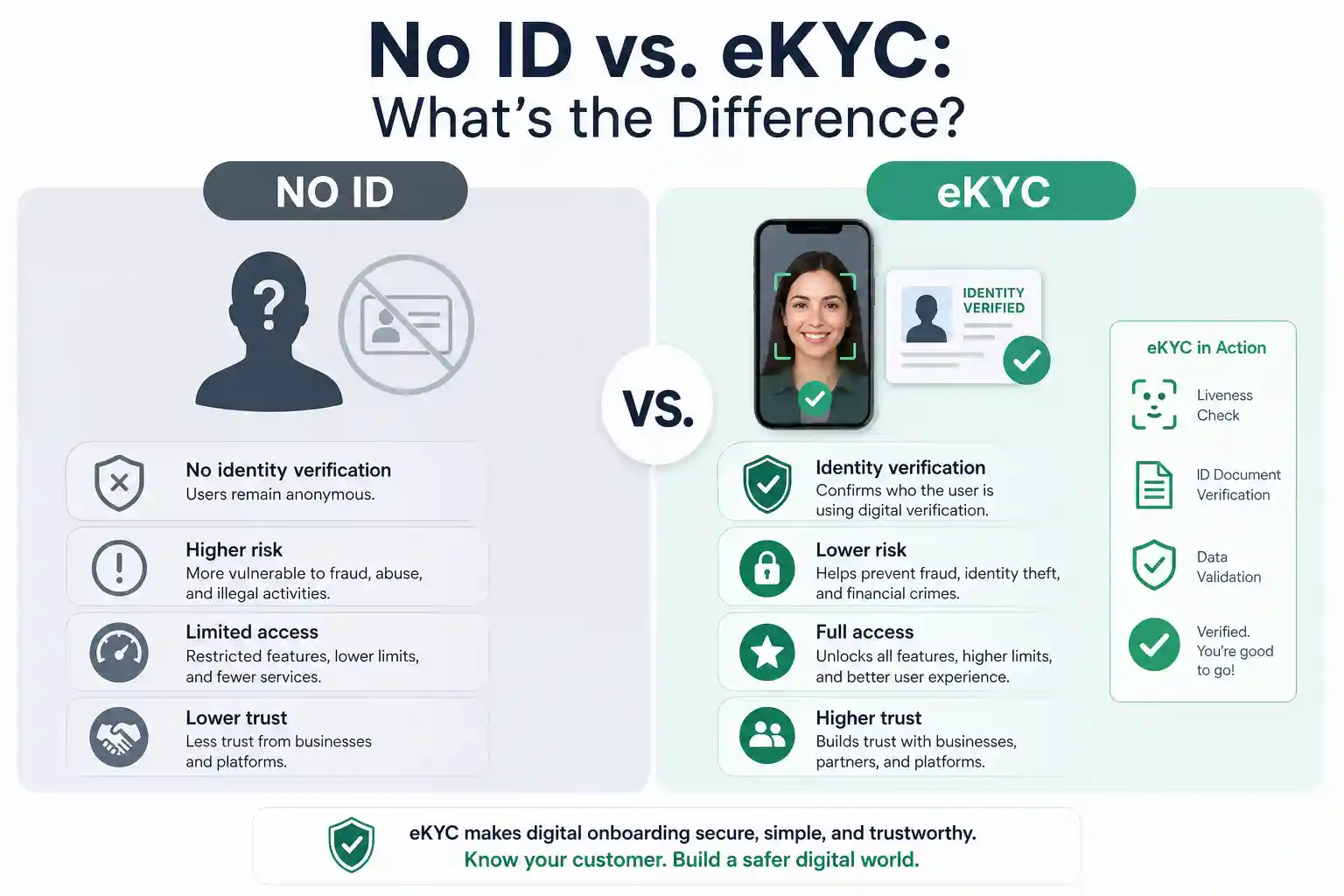
eKYC stands for “electronic Know Your Customer.” It is the modern, digitised evolution of traditional KYC protocols. While traditional KYC often required customers to physically present paper documents (such as a passport or utility bill) at a branch or wait days for manual verification, eKYC moves the entire procedure online.

BetPortal
- Lucky Friday: 50% Friday Reload Bonus
- Wild Wednesday: 250 Free Spins
- Riskfree Weekend: 10% Cashback





The primary goal of eKYC remains the same as its predecessor: to verify a user’s identity securely, prevent fraud, combat money laundering (AML), and ensure regulatory compliance. However, the execution is entirely driven by advanced digital infrastructure.
Key Technologies Powering eKYC
Modern eKYC systems rely on a sophisticated blend of software and hardware to authenticate users remotely. The most common technologies include:
- Optical Character Recognition (OCR): This technology automatically extracts data from uploaded images of identity documents (like a UK driving licence) and inputs it into the system, eliminating manual data entry.
- Biometric Authentication: By requiring users to take a live selfie, eKYC systems use facial recognition software to match the user’s face with the photograph on their official ID document.
- Liveness Detection: To prevent fraudsters from using static photos or deepfakes, liveness detection requires users to perform small actions (like blinking or turning their head) to prove they are physically present.
- NFC (Near Field Communication): Many modern eKYC platforms can scan the embedded microchips in biometric passports using a smartphone’s NFC reader, extracting highly secure, cryptographic data directly from the document.
- Bank-Verified Identity: In the UK, innovative solutions like OneID leverage data already verified by a user’s bank. With the user’s explicit consent, the bank shares verified identity signals, streamlining the onboarding process without requiring new document uploads.
- AI and Machine Learning: These algorithms run in the background to detect inconsistencies, flag fraudulent patterns, and cross-reference user data against global watchlists in real-time.
For UKGC-licensed online casinos, eKYC is an absolute necessity. The UKGC strictly mandates that operators verify a player’s age and identity before they are allowed to deposit funds or play games.
What are “No ID” (No KYC) Platforms?
On the other end of the spectrum are “No ID” or “No KYC” platforms. These are digital services—most notably offshore online casinos and cryptocurrency exchanges—that allow users to register, deposit, play, and sometimes withdraw funds with minimal to zero identity verification.
While the term “No ID” sounds absolute, the reality is often more nuanced. In the online gambling sector, these platforms typically fall into three distinct categories:
- “No Documents Immediately” (Deferred KYC): These platforms allow instant registration using just an email address and password. Players can deposit and play immediately. However, when it comes time to withdraw significant winnings, the platform will suddenly trigger a manual KYC request.
- Low KYC / E-Verification: These sites run basic electronic background checks based on the minimal data provided at registration. They only ask for physical ID uploads if the user’s activity triggers a risk flag or exceeds certain financial thresholds.
- True “No KYC Ever”: These are platforms where users can deposit, play, and withdraw large sums completely anonymously. They almost exclusively rely on cryptocurrencies (like Bitcoin or Ethereum) and blockchain technology to process transactions, bypassing traditional fiat banking systems entirely.
The Regulatory Reality of No ID Sites in the UK
It is crucial to understand that no UKGC-licensed casino can operate as a true “No ID” platform. The UKGC’s strict guidelines require identity verification prior to any gambling activity to protect minors and prevent financial crime. Therefore, any online casino advertising “No ID” or “No KYC” to British players is operating from an offshore jurisdiction (such as Curaçao, Panama, or Anjouan) and does not hold a UK licence.
While these platforms attract users seeking privacy, faster access, and avoidance of UK specific restrictions like GamStop, they come with significant risks, including a lack of formal dispute resolution and fewer responsible gambling safeguards.
No ID vs. eKYC: A Detailed Comparison
To fully grasp the difference between No ID and eKYC, we must compare them across several critical dimensions: user experience, security, privacy, and regulatory compliance.
1. Speed and User Experience
eKYC: While infinitely faster than traditional paper-based KYC, eKYC still introduces friction. Users must have their physical ID on hand, ensure good lighting for a selfie, and wait for the AI to process the documents. Although modern systems can complete this in minutes, errors in document reading or poor photo quality can lead to frustrating delays or manual review.
No ID: The user experience is heavily prioritised. Registration is instantaneous, often requiring nothing more than an email, a password, or linking a Web3 crypto wallet. Players can access the platform and begin engaging within seconds, bypassing the onboarding friction completely.
2. Privacy and Anonymity
eKYC: Privacy is tightly managed but anonymity is non-existent. Users must surrender highly sensitive personal data, including their legal name, home address, date of birth, and biometric data. While eKYC platforms use encryption to protect this data, users must trust the operator to store it safely and comply with GDPR.
No ID: These platforms are heavily favoured by privacy advocates. By not requiring identity documents, No ID sites allow users to maintain a high level of anonymity online. Financial privacy is also maintained, especially when using cryptocurrencies, as transactions do not appear on traditional bank statements.
3. Security and Fraud Prevention
eKYC: eKYC provides a robust, institutional-grade security framework. By combining biometrics, liveness checks, and AI-driven document analysis, eKYC effectively weeds out underage users, blocks money launderers, and prevents bonus abuse. It also integrates seamlessly with national self-exclusion schemes like GamStop in the UK.
No ID: Security is a double-edged sword. While users don’t risk their personal data being stolen in a data breach, the platform itself is highly vulnerable to exploitation by bad actors. Furthermore, the lack of oversight means players have little to no recourse if an offshore casino refuses to pay out a legitimate win.
4. Regulatory Compliance and Market Access
eKYC: Compliance is the main driver behind eKYC. For a business to operate legally within the UK’s financial or gambling sectors, implementing stringent eKYC is mandatory. It protects the operator from massive regulatory fines and ensures a safe ecosystem for consumers.
No ID: These platforms operate in a regulatory grey area or entirely outside UK law. They purposefully avoid stringent licensing jurisdictions to offer their services globally. The UKGC actively works to block these sites and restrict payment providers from processing their transactions.
Comparison Table: eKYC vs. No ID Casinos
The following table breaks down the distinct differences between eKYC-compliant platforms (such as UKGC-licensed casinos) and No ID offshore platforms:
| Feature / Metric | eKYC Platforms (UKGC Licensed) | No ID Platforms (Offshore) |
|---|---|---|
| Registration Time | 2 to 5 minutes (requires document scanning) | Instant (under 30 seconds) |
| Data Required | Full name, address, DOB, ID document, selfie | Email address, password, or crypto wallet |
| Anonymity | None. Full disclosure is mandatory. | High. Minimal personal details required. |
| Payment Methods | Fiat currencies (Debit cards, bank transfers, e-wallets) | Primarily Cryptocurrencies (Bitcoin, USDT, Ethereum) |
| Withdrawal Speeds | 24 to 72 hours (subject to AML checks) | Near-instant to 24 hours (via blockchain) |
| Regulatory Oversight | Strict (UK Gambling Commission) | Loose (Curaçao, Costa Rica, Anjouan) |
| Player Protection | High (Mandatory GamStop, strict deposit limits) | Low (Basic self-exclusion, no network-wide blocks) |
| Fraud Prevention | High (AI, biometrics, bank-verification) | Low (Relies on basic IP tracking or delayed KYC) |
Pros and Cons Summarised
To make an informed decision as a consumer or an operator, it is essential to weigh the advantages and disadvantages of both systems.
Pros and Cons of eKYC
Pros:
- Guarantees compliance with strict UK legal and AML frameworks.
- Highly secure, drastically reducing the risk of identity theft and synthetic fraud through AI and biometrics.
- Provides robust consumer protection, including mandatory access to responsible gambling tools like GamStop.
- Eliminates the need for physical, in-person verification, saving time and resources compared to traditional KYC.
Cons:
- Creates friction during the onboarding process, which can lead to user drop-off if the technology fails to read a document properly.
- Requires users to hand over sensitive personal and biometric data, raising privacy concerns for some.
- Processing times for withdrawals can be delayed due to mandatory security and affordability checks.
Pros and Cons of No ID Platforms
Pros:
- Offers instant, frictionless access to the platform without the hassle of scanning documents.
- Protects user privacy by keeping personal data completely off the platform’s servers.
- Enables near-instant financial transactions, particularly when using decentralised cryptocurrencies.
- Often provides access to larger bonuses and fewer gameplay restrictions due to the lack of regulatory overhead.
Cons:
- Operates without a UKGC licence, meaning UK players have no legal protection if a dispute arises.
- Often utilises deceptive practices, such as advertising as “No ID” but demanding documents when a player attempts a large withdrawal.
- Lacks essential responsible gambling safeguards, making it dangerous for vulnerable individuals seeking to bypass GamStop.
The UK Regulatory Landscape in 2026
As of 2026, the regulatory environment in the United Kingdom has become exceptionally stringent. The UKGC has introduced sweeping reforms to its Licence Conditions and Codes of Practice (LCCP). These updates include a new 40% Remote Gaming Duty, strict limits on slot stakes, and enhanced requirements for operator transparency.
Furthermore, from November 2025 onwards, corporate compliance has also tightened, with directors and persons with significant control (PSCs) required to complete digital ID verification to operate legally. In the consumer space, the UKGC, backed by increased government funding, has ramped up its enforcement against illegal, unlicensed No ID casinos, working closely with internet service providers and payment processors to block access.
Simultaneously, the UK market is seeing a shift towards Bank-Verified Identity solutions. Rather than forcing users to upload driving licences and take selfies, operators are increasingly integrating with UK banks to verify identities seamlessly in the background. This hybrid approach offers the frictionless onboarding that No ID users crave, while maintaining the ironclad compliance that the UKGC demands.
Which One Should You Choose?
The choice between an eKYC platform and a No ID platform ultimately comes down to what a user values most: safety and regulation, or privacy and speed.
For the vast majority of UK consumers, eKYC platforms are the recommended choice. Engaging with a UKGC-licensed casino or a regulated financial app guarantees that your funds are secure, the games are fair, and you have legal recourse if something goes wrong. The minor inconvenience of a two-minute digital verification process is a small price to pay for institutional-grade security and consumer protection.
Conversely, while No ID platforms offer appealing benefits like rapid onboarding and cryptocurrency integration, they carry substantial risks for UK residents. By stepping outside the regulated market, users forfeit their protections. If an offshore site decides to freeze an account or refuse a payout, the player has virtually no way to recover their funds.
Conclusion
The evolution of digital identity verification has created two distinct paths. eKYC represents the regulated, secure, and compliant future of the internet, utilising cutting-edge AI and biometrics to protect businesses and consumers alike. On the other hand, No ID platforms cater to a niche audience seeking absolute privacy and speed, though they operate in the risky, unregulated shadows of the web. As UK regulations continue to tighten in 2026, the sophisticated, frictionless eKYC solutions—such as Bank-Verified Identity—will likely become the gold standard, bridging the gap between user convenience and mandatory compliance.