No verification casinos are usually not the safest option for UK players because a genuinely “no KYC” gambling site normally sits outside the UK’s regulated system and does not provide the same legal protections as a UKGC-licensed operator. Some of these casinos may offer fast registration, crypto payments, and fewer onboarding checks, but convenience does not remove the risks linked to weak oversight, delayed withdrawal checks, and limited player protection.
What “No Verification” Really Means
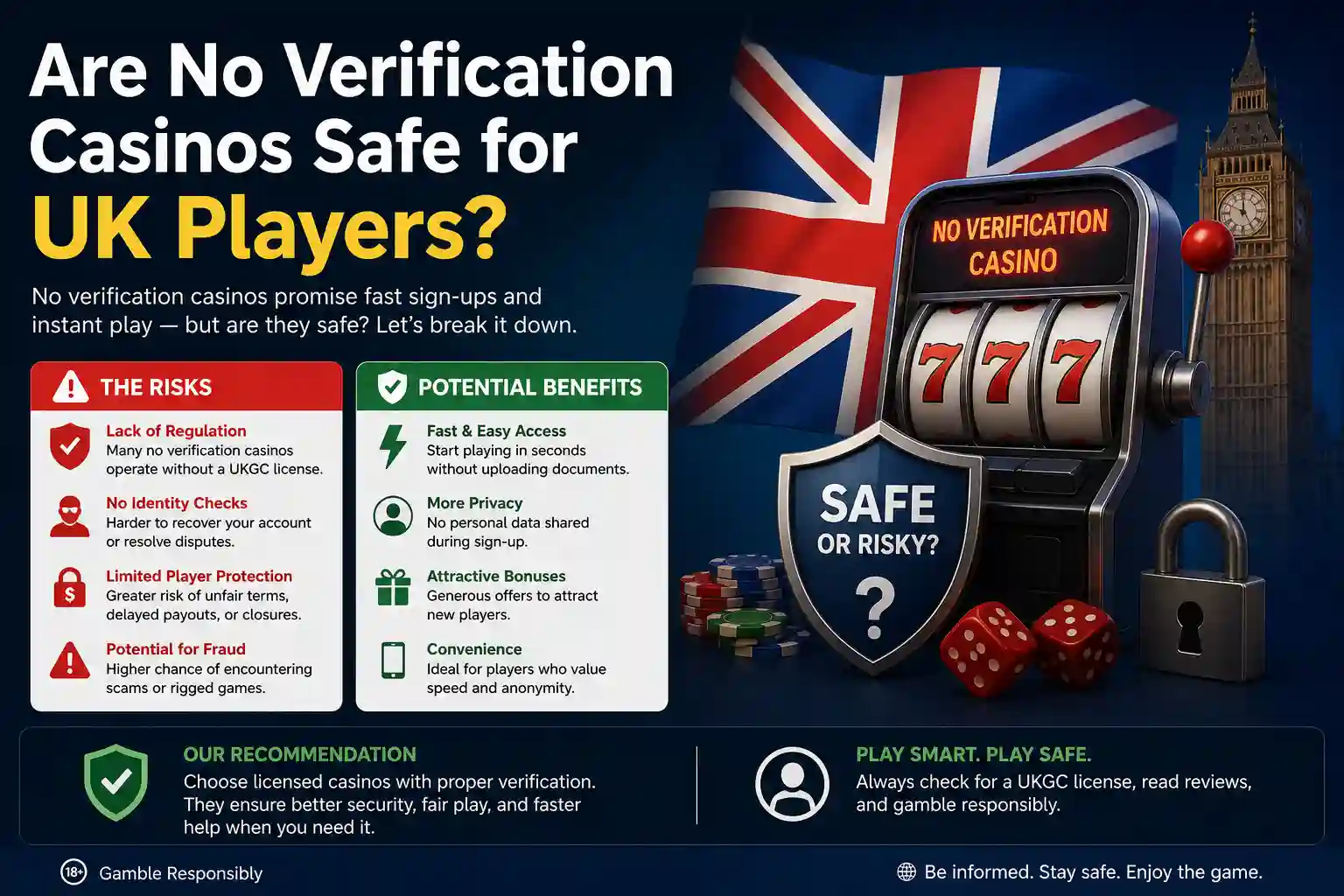
The phrase “no verification casino” sounds simple, but in practice it can describe several different types of platforms. Some sites let users create an account and deposit without uploading documents straight away, while others market themselves as fully anonymous casinos that supposedly never request proof of identity at all.

BetPortal
- Lucky Friday: 50% Friday Reload Bonus
- Wild Wednesday: 250 Free Spins
- Riskfree Weekend: 10% Cashback



For UK players, that distinction matters. A casino that only delays checks until the withdrawal stage is very different from an offshore crypto platform that tries to avoid identity checks entirely. The first model may still involve some kind of licensing in another jurisdiction, while the second often exists outside the standards that British players would normally expect from a regulated gambling environment.
This is also why the marketing around these brands can be misleading. A site may advertise “no ID needed,” yet still reserve the right to block a cashout until the player sends a passport, proof of address, source-of-funds evidence, or payment confirmation documents. In other words, many so-called no verification casinos are not truly verification-free; they simply shift the KYC process to the moment when the player wants to access their winnings.
That model appeals to many users because it removes friction at signup. A player can register quickly, deposit in minutes, and start playing without the document checks that are common on regulated UK sites. The problem is that a faster start does not guarantee a smooth finish, especially if the casino later decides to scrutinise the account more aggressively when a withdrawal request arrives.
Why UK Players Face Higher Risk
For players in Great Britain, the core issue is regulation. Online gambling operators that legally target British consumers are expected to hold a UK Gambling Commission licence, and UKGC rules require identity and age verification as part of the regulated player-protection framework. That means a platform promising permanent no-verification access to UK customers is usually operating outside the structure designed to protect those customers.
This has several consequences. First, UK players on offshore no KYC sites may not benefit from the same standards around dispute handling, safer gambling tools, transparent terms, or regulatory accountability that apply to licensed UK operators. Second, if a disagreement arises over a bonus, a withdrawal, or a closed account, the player’s options for formal complaint can be far weaker than they would be with a UKGC-licensed casino.
Another major issue is responsible gambling. Many no verification casinos promoted to British users operate outside services such as GamStop, which means self-excluded players can potentially access gambling websites that do not honour the UK’s exclusion framework. For vulnerable users, that is not a feature but a serious risk, because it allows them to bypass a system that exists to reduce gambling-related harm.
There is also a legal and practical trust problem. A UK player may assume that because a site has English language support, accepts pounds, or mentions British users, it must be safe for the UK market. In reality, those signals do not replace proper regulation, and attractive front-end design does not guarantee fair treatment when money is on the line.
The table below shows the difference more clearly.
| Feature | UKGC-licensed casino | Delayed KYC offshore casino | “True” no verification casino |
|---|---|---|---|
| Licensing expectation | Must operate under UKGC rules for British customers | Usually licensed elsewhere, not under UKGC standards for UK players | Often offshore or weakly regulated, sometimes with unclear oversight |
| Identity checks | Required as part of the regulated system | Often postponed until withdrawal or account review | Marketed as minimal or absent, though terms may still change later |
| Consumer protection | Stronger complaint and compliance structure | More limited, depends on the jurisdiction | Often weakest level of protection |
| GamStop coverage | Integrated into the UK safer gambling ecosystem | Commonly outside GamStop | Typically outside GamStop |
| Main appeal | Legal access and higher protection | Faster signup and lighter early checks | Anonymity and speed, often with crypto |
| Main danger | Less anonymity for the player | Documents may be demanded at the worst moment | High risk of disputes, weak recourse, unclear fairness |
Are They Ever Safe?
The honest answer is that “safe” depends on what standard you are using. If safety means technical security alone, some offshore casinos may use SSL encryption, modern payment tools, and game systems that look professionally run. A site can therefore appear secure on the surface, especially if it offers clean design, fast loading times, crypto transactions, and responsive customer support.
However, UK players should think about safety more broadly than just encryption. A casino can protect data reasonably well and still be unsafe in legal, financial, and practical terms if it refuses withdrawals, changes bonus conditions, or demands new verification documents after a big win. From that wider consumer perspective, no verification casinos are still a riskier category than properly licensed UK sites.
This is where many players get caught out. They focus on the easy deposit and forget that the real test of a casino is how it behaves when the player wants their money back. A platform that feels frictionless before gambling can become highly restrictive the moment a profitable account needs to be reviewed.
That does not mean every offshore or delayed-KYC casino is automatically fraudulent. Some may process payouts fairly and maintain decent operating standards, but the user is still accepting weaker protections and higher uncertainty than they would on a regulated UK site. In content terms, this is the key point: the issue is not only whether a no verification casino can be safe, but whether it is safe enough for a UK player who wants reliable recourse if something goes wrong.
Main Risks for British Players
The first major risk is withdrawal friction. Many sites advertised as “no verification” still conduct checks at payout stage, which means the player may only discover the true rules after building a balance or winning a meaningful amount. If the documents requested are extensive, unclear, or repeatedly rejected, the player can end up in a long dispute with little leverage.
The second risk is weak dispute resolution. On a UKGC-licensed platform, the operator is subject to a stricter compliance culture and clearer obligations toward the player. On an offshore site, even when some form of licence exists, the route to challenge an unfair decision may be slower, less transparent, or practically ineffective for a UK resident.
The third risk is responsible gambling failure. Because many no verification casinos sit outside GamStop and related UK safer gambling structures, a self-excluded person can potentially register and continue gambling when they should not have that access. For British audiences, this is one of the most serious arguments against treating no KYC casinos as harmless alternatives.
The fourth risk is terms-and-conditions abuse. A site may promote anonymous play in its marketing while hiding strict clauses in the legal pages that allow it to request documents at any time, limit certain countries, cancel winnings linked to bonus interpretation, or suspend accounts pending “security review.” Once a player has already deposited, these hidden terms matter far more than the original advertising message.
The fifth risk involves payment and source-of-funds scrutiny. Even where a casino accepts crypto or alternative payment methods, it may still decide to investigate transaction history later, especially after larger wins or unusual betting activity. That means the promise of anonymity may be much narrower than the player assumed when signing up.
The sixth risk is simple market confusion. British users may search for “no verification casino UK” and assume that search visibility equals legitimacy, but advertising language alone tells you very little about how the business behaves under pressure. A polished affiliate-style presentation can make a risky site feel mainstream even when the legal and consumer-protection position is much weaker than that of a UK-licensed operator.
- Claims of “guaranteed no ID withdrawals” aimed directly at UK players.
- Vague or hidden licensing information.
- Terms that allow verification “at any time” despite no-KYC marketing.
- No link to UK safer gambling systems such as GamStop.
- Unclear complaint channels or generic customer support answers.
- Heavy promotion of anonymity while downplaying payout rules.
Smarter Alternatives for UK Users
For most British players, the safer path is not a fully anonymous casino but a regulated site that offers fast onboarding and fast withdrawals without abandoning compliance. Some licensed operators use streamlined verification methods and digital checks, which can reduce friction while still keeping the player inside a legal and protected environment. That is usually a far better trade-off than moving to an offshore platform purely to avoid uploading documents at registration.
If a player is considering a no verification brand anyway, they should at least approach it with a much stricter checklist. They should read the withdrawal policy before depositing, check exactly when KYC can be triggered, review the casino’s licensing disclosures, and treat big “no ID” promises as marketing rather than guarantees. This does not remove the risk, but it reduces the chance of being surprised by conditions that only appear after a win.
A practical decision framework for UK players looks like this:
- Check whether the casino is licensed for the UK market, because that is the clearest dividing line between regulated protection and offshore risk.
- Treat “no verification” as a phrase that often means “not yet verified,” not “never verified.”
- Assume that any large or successful account may still face document requests later.
- If the site is outside GamStop, recognise that this may be dangerous rather than convenient.
- Prioritise withdrawal reputation over signup speed, because payout reliability is the true measure of operational trust.
FAQ
Do no KYC casinos ever ask for ID later?
Yes, many so-called no verification casinos only delay the KYC process until the player tries to withdraw or reaches a certain account threshold. That means “no verification” often really means “no verification at signup,” not “no verification forever.”
Why do UK players use no verification casinos?
The main reasons are faster registration, fewer onboarding checks, and the appeal of more privacy during the early stages of account use. Some players are also attracted by crypto payments and access outside UK safer gambling systems, although that can increase risk rather than reduce it.
Can I withdraw winnings without verification?
Sometimes small withdrawals may be processed without immediate checks, but many offshore casinos reserve the right to request documents before releasing winnings. This is one of the biggest risks for UK players because the real verification process may only start when they try to cash out.
Are no verification casinos on GamStop?
Many no verification casinos promoted to British users operate outside GamStop and other UK safer gambling protections. For self-excluded players, that creates a serious risk because it allows access to gambling sites that do not follow the UK exclusion framework.
How can I spot a risky no verification casino?
Common warning signs include vague licensing details, aggressive “no ID withdrawal” claims, hidden KYC clauses in the terms, and weak complaint procedures. A casino that markets anonymity heavily but says little about payout rules should be treated with caution.
Are crypto no KYC casinos safer than regular offshore casinos?
Crypto payments can improve transaction speed and privacy, but they do not automatically make a casino safer for UK players. A crypto casino can still be risky if it lacks strong licensing, clear terms, or a trustworthy withdrawal history.
What is the safest alternative for UK players?
The safer option is usually a UKGC-licensed casino that offers fast withdrawals and streamlined digital verification rather than a fully anonymous offshore site. That way, players get quicker access to games while keeping the legal protections and responsible gambling safeguards of the regulated UK market.
Should UK players trust “no verification” marketing claims?
Not without checking the terms carefully, because many sites use “no verification” as a marketing hook while still keeping the right to request documents later. For UK players, payout reliability and regulatory protection matter much more than a fast signup page.