

This guide is built for beginners who want a clean, simple answer to one question: how do you actually deposit at a no ID casino using crypto without making costly mistakes? We will break the process down step by step, explain what “no ID” really means, show which coins are easiest for first deposits, and help UK readers understand the extra regulatory context that competitors often gloss over.
What “No ID” really means
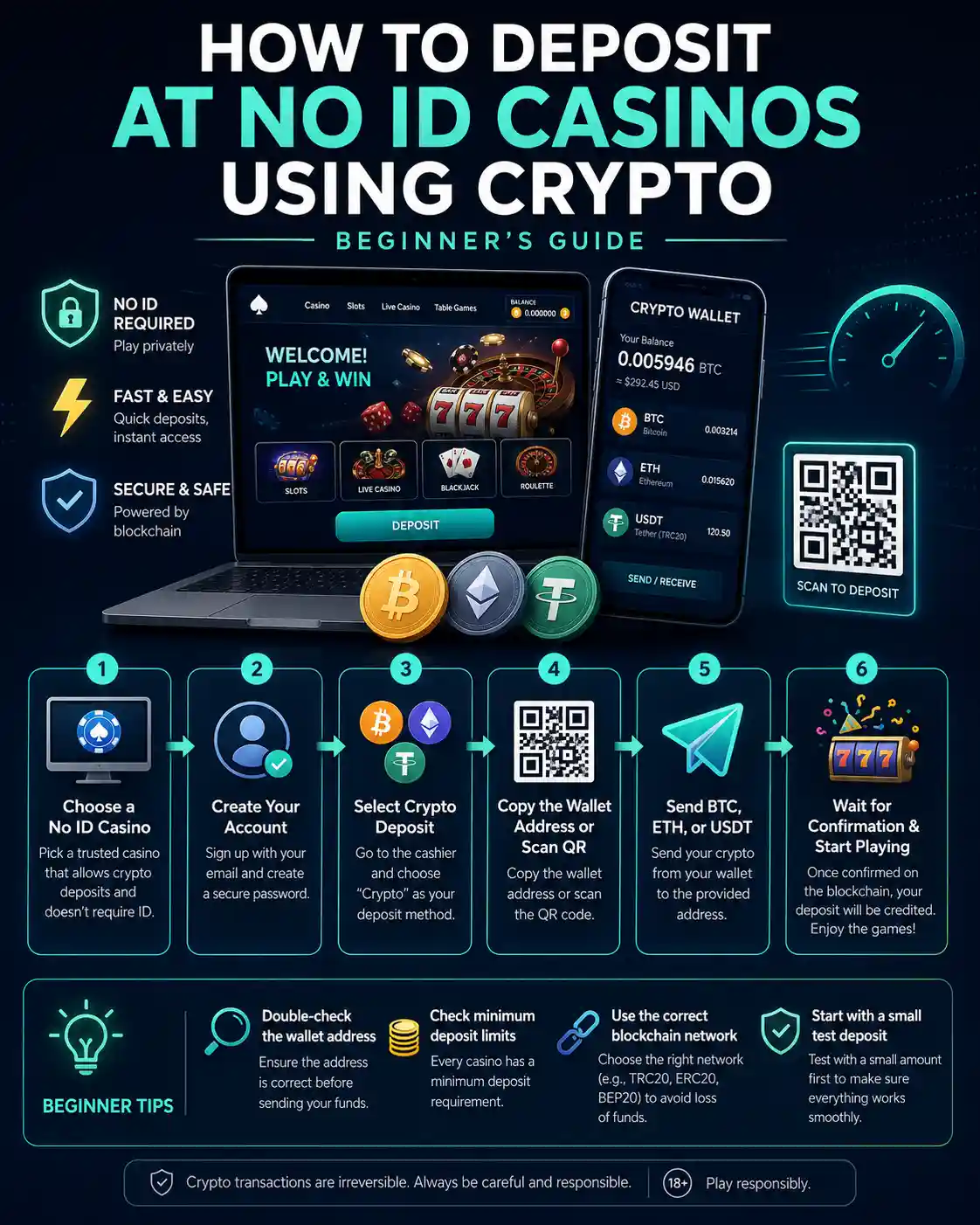
A no ID casino, often called a no KYC casino, is an online gambling platform that lets players register and usually deposit with minimal personal information, often just an email address or a wallet connection.
In many cases, you can deposit, play, and make routine withdrawals without uploading a passport, proof of address, or a selfie.
That said, “no ID” does not mean “no rules,” because many platforms still apply transaction monitoring, fraud checks, or verification requests for large, unusual, or flagged withdrawals.

BetPortal
- Lucky Friday: 50% Friday Reload Bonus
- Wild Wednesday: 250 Free Spins
- Riskfree Weekend: 10% Cashback





That distinction matters. A true beginner should understand that no KYC usually means low-friction onboarding for normal play, not guaranteed anonymity under every circumstance.
Several leading guides stress that large cashouts, suspicious activity, multi-accounting, or breaking posted limits can trigger manual review.
So the smart goal is not simply “avoid verification forever,” but rather “deposit correctly, play normally, and keep your first withdrawal smooth.”
No ID vs traditional casino
| Feature | No ID crypto casino | Traditional verified casino |
|---|---|---|
| Sign-up | Often email-only or wallet-based. | Usually requires more account data and stronger identity checks over time. |
| Deposit method | Crypto-first, using on-chain payments. | Cards, bank transfers, e-wallets, and standard fiat rails. |
| Withdrawal speed | Often much faster for routine crypto cashouts. | Commonly slower because of manual checks and banking delays. |
| Privacy | Higher for normal use, but not unlimited in every case. | Lower, because ID and address verification are standard. |
| UK fit | Usually offshore for UK-facing crypto play. | UK-licensed operators follow stricter compliance and do not currently accept direct crypto deposits. |
Before you deposit
Before you send a single pound’s worth of crypto, you need a clean setup. Most top pages mention the deposit itself, but beginners benefit much more from understanding what to prepare before they even open the cashier.
1) Choose the right type of wallet 🔐
For privacy and control, current guides recommend using a personal wallet rather than leaving funds sitting on an exchange account.
A non-custodial wallet gives you control of your private keys, which is better for security and for separating casino activity from your main holdings.
It also makes it easier to manage deposits, withdrawals, and wallet addresses consistently.
Beginner tip: Create one wallet just for gambling activity. That keeps your casino transactions separate from your long-term crypto holdings and reduces confusion when checking balances or tracking withdrawals.
2) Pick a beginner-friendly coin 🪙
Not every cryptocurrency is equally beginner-friendly. Many current guides highlight LTC and USDT on TRC20 as attractive options because they usually offer low fees and relatively fast settlement, while BTC remains popular because it is supported almost everywhere.
ETH is also common, but fees can be more variable depending on network congestion.
If a casino supports XMR, some guides note that it offers stronger privacy, though support is more limited than BTC, LTC, or USDT.
3) Enable security before you fund the account 🛡️
A strong password and two-factor authentication are basic protection steps that top reviews repeatedly recommend.
Even if a casino does not ask for ID, you still want solid account security because a hacked account is far worse than a slow deposit.
If 2FA is available, turn it on before your first deposit, not after.
4) Read the cashier page, not just the homepage 👀
One of the biggest beginner mistakes is trusting the banner and ignoring the cashier details. Leading guides specifically say you should check deposit minimums, supported coins, networks, fees, and withdrawal thresholds inside the cashier or terms before sending funds.
This is where you learn whether the site accepts BTC only, whether USDT must be sent on TRC20, or whether larger withdrawals can trigger checks.
If the cashier is vague, that is a red flag.
5) Decide whether to use a bonus 🎁
This is where many beginners go wrong. Bonus-heavy competitor pages promote giant welcome offers, but more careful guides point out that high wagering, max-win caps, or restricted cashout rules can complicate your first withdrawal.
For a smooth first experience, cash-only play or a low-rollover cashback offer is often cleaner than claiming a big headline bonus.
If your goal is to test the cashier and confirm that deposits and withdrawals work properly, simplicity beats hype.
💡 Smart beginner move: Skip the bonus on your first deposit unless you fully understand the wagering terms.
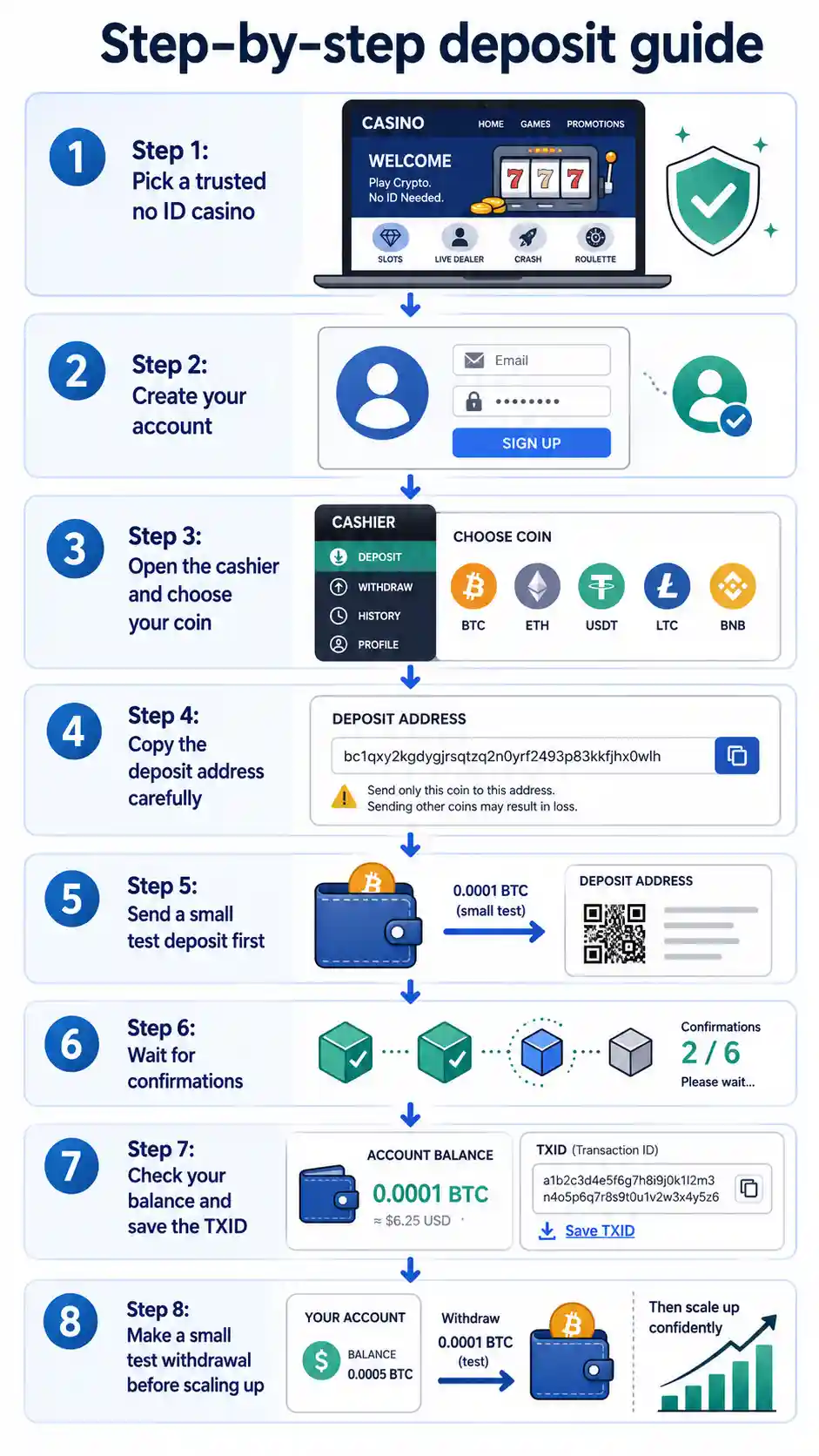
Now let’s go through the full process from zero to funded account.
Step 1: Pick a trusted no ID casino
Start with the basics: check whether the site clearly lists its supported coins, payout policies, security features, and customer support options.
Top guides also suggest checking reputation, licensing disclosure, and whether the platform has a history of honoring routine no-verification withdrawals.
For UK readers, remember that this space generally points toward offshore platforms rather than UK-licensed brands because UK-licensed operators are not currently allowed to accept direct crypto deposits.
What to look for:
- Email-only or wallet-based sign-up.
- Clear cashier page with listed coins and networks.
- 2FA, HTTPS/SSL, and visible security settings.
- Responsive support, ideally 24/7 live chat.
- Transparent rules for withdrawals and limits.
Step 2: Create your account
Most no ID casinos use a simple registration flow. You usually enter an email address, set a password, and verify the account if needed by email rather than by submitting documents.
Some platforms even allow wallet-based access with minimal traditional sign-up data.
At this stage, use a strong unique password and activate 2FA immediately.
Beginner checklist:
- Use an email you can access easily.
- Save your password in a password manager.
- Turn on 2FA before depositing.
- Read the cashier rules once before funding.
Step 3: Open the cashier and choose your coin
Once your account is active, go to the cashier, banking, or wallet section. That is where the casino will show you the supported deposit methods and generate a unique deposit address for your account.
If you are using BTC, LTC, ETH, or USDT, the cashier should specify the exact coin and, where relevant, the exact network.
This detail is critical, especially for tokens like USDT, which may exist on multiple networks such as TRC20 or ERC20.
⚠️ Golden rule: Always send the exact coin on the exact network shown in the cashier. Sending the right coin on the wrong network can lead to lost or delayed funds.
Step 4: Copy the deposit address carefully
The casino will usually generate a wallet address or QR code. Your job is to copy it exactly and then double-check it before sending.
Crypto transactions are generally irreversible, so accuracy matters far more here than with card payments.
A good beginner habit is to compare the first six and last six characters after pasting the address into your wallet or exchange withdrawal screen. This adds a simple human check before you confirm.
Step 5: Send a small test deposit first
This is one of the strongest repeated themes across the current SERP. Multiple leading pages recommend starting with a small amount, especially if you are using a new casino or a coin/network combination you have not used before.
A small test deposit helps you confirm that the address is correct, the network is supported, and the casino credits balances properly before you send more.
It also reduces the cost of any mistake.
Example: If you plan to deposit £300 worth of LTC, send a small test amount first, wait for it to arrive, and only then send the full bankroll. This is not paranoia — it is standard crypto hygiene.
Step 6: Wait for confirmations
After you send the transaction, the casino usually waits for a certain number of blockchain confirmations before crediting the balance.
The time depends on the coin, the network, and current congestion.
Many no KYC sites process this automatically, so once the required confirmations arrive, your balance should update without manual action.
Step 7: Check your balance and save the TXID
If the deposit takes longer than expected, the transaction ID — usually called the TXID — is your best friend. Current guides recommend saving it because support can use it to trace the transfer if needed.
Do not throw it away. If anything goes wrong, the TXID is the proof that you sent the funds.
This is especially useful for beginners who panic when a balance does not appear instantly.
Step 8: Make a small test withdrawal before scaling up
A lot of beginner content stops after the deposit, but that is not enough. Some of the best top-ranking pages recommend running a small withdrawal test before making bigger deposits or longer sessions.
This helps confirm that the casino pays out on the same coin/network, that your wallet address works correctly, and that no surprise review is triggered for routine activity.
For first-time users, this is the fastest way to turn uncertainty into confidence.
Best coins for beginners
Not sure which coin to use first? Here is the practical breakdown.
Beginner coin table
| Coin / Network | Why beginners use it | Main downside | Best use case |
|---|---|---|---|
| BTC | Broad support across crypto casinos. | Fees and confirmation times can vary during congestion. | Good if you already hold Bitcoin and want maximum compatibility. |
| LTC | Low fees and fast settlement are repeatedly highlighted as beginner-friendly. | Fewer “brand” headlines than BTC, so some new users overlook it. | Great first test deposit or frequent smaller withdrawals. |
| USDT (TRC20) | Stable value plus low-fee, fast transfers on Tron are often recommended. | Easy to make a mistake if you choose the wrong USDT network. | Good if you want to avoid crypto price swings during play. |
| ETH | Strong liquidity and wide support. | Gas fees can be unpredictable. | Fine for experienced users who already use Ethereum wallets. |
| XMR | Higher privacy where supported. | Support is more limited. | Better for privacy-focused users who already understand Monero basics. |
My beginner-friendly ranking
For a first deposit, the easiest path is usually:
- LTC — simple, low fee, fast.
- USDT on TRC20 — stable value and good speed, but only if you understand network matching.
- BTC — universal and familiar, though sometimes a little slower or more expensive.
If you are completely new to crypto, the best beginner question is not “which coin is the most private?” but “which coin can I send confidently without making a network mistake?” For many users, that makes LTC the cleanest place to start.
Fees, limits, and the traps beginners miss
Depositing is easy. Depositing well takes a little more awareness.
1) Verification thresholds still matter
One major insight from current rankings is that many “no ID” casinos still operate with thresholds for routine no-verification withdrawals. Some guides mention typical anonymous withdrawal ranges in the low-to-mid thousands, while others note that unusually large or irregular activity can trigger checks.
So if you want the smoothest beginner experience, do not make your very first transaction unusually large.
Normal, modest, consistent activity is less likely to create friction than one giant first withdrawal.
2) Bonuses can slow down your first cashout
This deserves repeating because competitors often oversell welcome offers. Several strong sources point out that wagering requirements, game weighting, max-win caps, and bonus abuse rules can complicate “easy” withdrawals.
If your real goal is to verify that the site handles your money correctly, a simple cash deposit with no bonus is often the cleaner path.
Bonuses can be useful later, once you understand the cashier flow and the platform’s rules.
3) Network mismatch is the #1 rookie mistake
When a casino says “USDT (TRC20),” that does not mean “send any USDT from anywhere.” It means send USDT on Tron, not USDT on Ethereum or another network.
The same idea applies to any token or chain-specific asset listed in the cashier.
Many deposit errors are not caused by bad casinos at all — they are caused by users who choose the wrong network in their wallet or exchange.
4) The deposit is only half the job
A beginner should always think in pairs:
- Which coin will I deposit with?
- Which coin/network will I withdraw with?
- Does the casino support both clearly?
- Do I understand the wallet address format?
- Can I test a small withdrawal after my first session?
That mindset is far better than obsessing over the size of a welcome bonus. Current expert guides repeatedly emphasize predictable withdrawals, consistent wallet usage, and modest first transactions.
What UK beginners should keep in mind 🇬🇧
- Check whether the site openly serves UK players and read its restricted countries page.
- Understand that offshore licensing standards vary.
- Do not assume “no ID” means “regulated like a UKGC site.”
- Keep records of deposits, withdrawals, and TXIDs.
- Start small, especially on your first site and first coin/network combination.
📌 Practical UK takeaway: If you are based in Britain and exploring this space for the first time, treat your first deposit as a technical test, not a big gambling event. That mindset alone will save you from many beginner errors.
Common mistakes and how to avoid them
Beginner mistake table
| Mistake | Why it happens | What can go wrong | Best fix |
|---|---|---|---|
| Sending USDT on the wrong network. | Beginners see the same ticker and assume every version is identical. | Funds may be delayed, misrouted, or difficult to recover. | Match the exact network shown in the cashier every time. |
| Depositing a large amount first. | New players trust the site too quickly or want a larger bonus. | Bigger loss if something goes wrong, plus possible extra review. | Send a small test deposit first. |
| Claiming a bonus without reading terms. | Welcome offers look attractive on landing pages. | Wagering or cashout rules can block a clean first withdrawal. | Go cash-only for your first test, or choose low-rollover offers. |
| Ignoring the TXID. | Users assume the balance will appear automatically. | Harder for support to trace a missing deposit. | Save the TXID as soon as you send the transfer. |
| Switching devices or IPs too often. | Users log in from multiple places without thinking. | Can trigger risk checks on some platforms. | Keep your setup consistent, especially during first deposit and withdrawal. |
| Leaving large balances on-site. | Convenience. | Extra platform risk if something goes wrong. | Withdraw regularly to your own wallet. |
Quick safety rules ✅
- Use a dedicated crypto wallet for casino play.
- Turn on 2FA before you deposit.
- Read the cashier page, not just the marketing page.
- Start with a test deposit.
- Save the TXID.
- Test a small withdrawal before scaling up.
Final beginner checklist
Before you hit “send,” run through this list:
- ✅ I understand that “no ID” does not always mean “no verification under every condition.”
- ✅ I know which coin I am using.
- ✅ I know which network I am using.
- ✅ I copied the exact deposit address.
- ✅ I enabled 2FA.
- ✅ I am starting with a small test deposit.
- ✅ I saved the TXID.
- ✅ I understand whether I am playing cash-only or with a bonus.
- ✅ I plan to test a small withdrawal before going bigger.
The best beginner strategy is simple: choose a trusted site, use a wallet you control, send a small test amount, match the exact network, skip complicated bonus terms, and confirm that both deposits and withdrawals work smoothly before increasing your bankroll.
FAQ for beginners
Is depositing at a no ID casino with crypto actually easy?
Yes — once your wallet is ready, the practical flow is usually simple: choose the coin, copy the deposit address, send funds, and wait for the required confirmations.
What makes it feel hard for beginners is not the deposit itself, but the need to understand wallets, addresses, and networks before sending.
Can a no ID casino still ask me for verification later?
Yes. Multiple current guides explain that “no KYC” generally applies to routine play, while large, unusual, or flagged withdrawals may still trigger checks.
That is why staying within posted limits and keeping your first transactions modest is a smart beginner strategy.
What is the safest first coin to use?
For many beginners, LTC is one of the easiest starting points because it combines low fees with fast settlement.
USDT on TRC20 is also attractive if you want stable value, but you must be careful to choose the correct network.
BTC remains the most widely supported, though fees and speed are less predictable than LTC or TRC20 in some situations.
Should I use a bonus on my first deposit?
Usually not, unless you have already read and understood the terms. Careful guides make clear that bonuses can add wagering, max-win rules, and other conditions that make first withdrawals less predictable.
If your goal is to test the site, go cash-only first.
Are these casinos legal in the UK?
The legal picture depends on the operator and the player’s circumstances, but one key point is clear: UK-licensed gambling operators are not currently allowed to accept direct cryptocurrency deposits.
That means UK-facing no ID crypto casino content usually concerns offshore platforms rather than UK-licensed domestic brands.
Because of that, players should check terms, country restrictions, and the platform’s rules before depositing.
What if my deposit does not show up?
First, check whether the transaction has the required confirmations on the blockchain. That is a normal reason for delay.
Second, make sure you sent the correct coin on the correct network.
Third, contact support and provide the TXID if the delay goes beyond the normal timeline shown in the cashier.