Want the short answer? Using a VPN in the UK is perfectly legal, but firing it up at a UK-licensed online casino is the fastest way to lose your winnings. You won’t face the police, but you will face something just as painful for a player: blocked accounts, frozen withdrawals, and voided jackpots.
Most articles give you the same shallow warning: “VPNs are legal, but casinos don’t like them.” That doesn’t help you. You need to know exactly how operators track you, what happens if you leave your VPN on by accident, and how to protect your online privacy without risking your money.
Quick answer
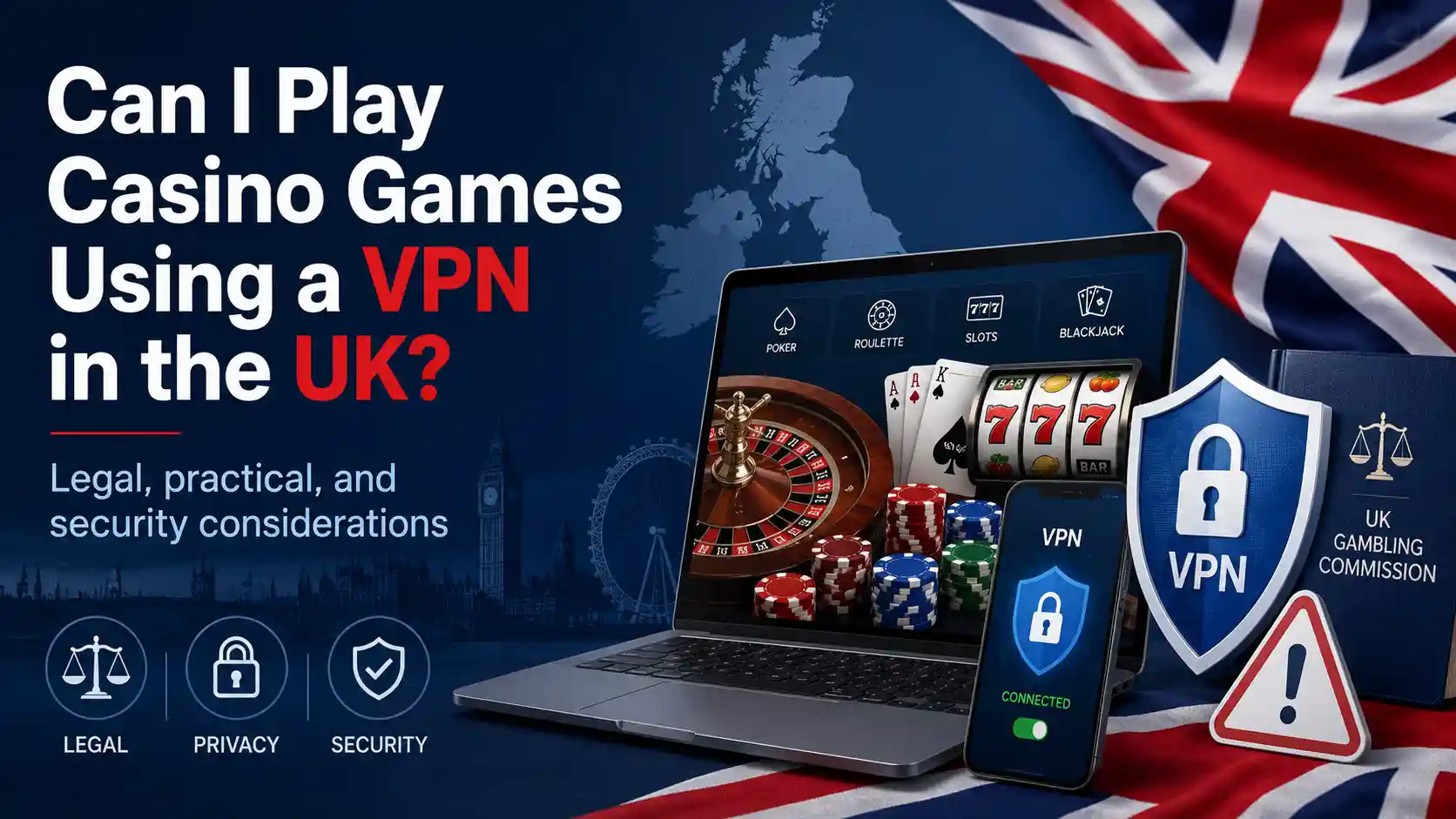
In everyday life, UK residents can legally use a VPN for privacy, work, safer public Wi‑Fi, or protecting personal data online. But when you log into a gambling site, the question changes from “Is a VPN legal?” to “Does this operator allow it, and can it affect my eligibility to play or withdraw?”

BetPortal
- Lucky Friday: 50% Friday Reload Bonus
- Wild Wednesday: 250 Free Spins
- Riskfree Weekend: 10% Cashback





For UK-licensed casinos, the safest assumption is this: if a VPN changes, hides, or confuses your location, it can create compliance problems for both you and the casino. Even if you are a genuine UK player and not trying to cheat, using a VPN can still trigger fraud checks, geolocation reviews, or manual account verification.
That is why the practical answer is not “yes” or “no” in isolation. It is: you can physically access the internet with a VPN, but you should not rely on a VPN while playing at UK-regulated casinos. If your goal is smooth play and hassle-free withdrawals, turn it off before gambling.
Why this matters to real players 🤔
A lot of players use VPNs automatically. They install one for streaming, travel, or cybersecurity, then forget it is running in the background. Later they log into a casino, deposit money, maybe even win, and only at withdrawal stage realize that the operator noticed unusual location data. That is where small mistakes can become expensive.
The core fear is simple:
- “Will my account be banned?”
- “Will my winnings be withheld?”
- “What if I used a VPN by accident?”
- “Does it matter if I’m still physically in the UK?”
- “Are offshore casinos different?”
Those are the right questions, and the answers depend on regulation, operator terms, and proof of location much more than on the VPN app itself.
The UK legal picture
Let’s separate the issue into two layers: public law and private platform rules.
1. VPNs are legal in the UK ✅
A VPN is not an illegal technology in Britain. UK-focused guidance from Norton explicitly frames the issue around the legality of VPNs in the UK, which indicates normal lawful use is accepted. In other words, browsing with a VPN, working remotely with a VPN, or securing your connection on public Wi‑Fi is not, by itself, a crime.
That matters because some players confuse “casino doesn’t allow it” with “government banned it.” Those are not the same thing. A tool can be lawful in general while still being restricted inside a specific service.
2. Gambling operators have their own compliance duties ⚖️
Once gambling enters the picture, the operator is no longer just a website owner. A UK-facing casino licensed under the British regulatory system has to care about who the player is, where the player is, and whether the play is allowed in that context. The UK Gambling Commission’s publication on player locations makes it clear that location is a regulatory issue, not a cosmetic preference.
That is why many UK-facing articles warn strongly against using VPNs at licensed casinos. The operator is not merely being strict for fun; it is trying to avoid regulatory risk, fraud exposure, and disputes about jurisdiction.
3. Legal does not mean permitted 🧩
This is the point many short articles miss. A VPN may be legal for you to own and use, but a casino can still say: “If you access our service through methods that hide or alter your location, we may suspend the account or invalidate activity under our terms.” UK-focused gambling content repeatedly frames VPN use at licensed casinos as something risky, unsafe, or not allowed in practice.
That means the real question is not whether you can download a VPN app. The real question is whether using it creates enough doubt about your location, identity, or eligibility that the casino no longer wants to process your play smoothly.
A simple way to think about it 💡
Imagine entering an airport with a hood, sunglasses, and a face covering. None of those items is illegal. But if security says, “We need to verify who you are before boarding,” that is a predictable response. In much the same way, a VPN is not automatically “bad,” but in gambling it can make a regulated operator think: why is this player masking location data?
That suspicion alone can cause friction:
- extra KYC checks,
- source-of-funds questions,
- delayed withdrawals,
- temporary account holds,
- requests for proof of address or travel context.
Even if you eventually pass those checks, the process may become slower and more stressful than it needed to be.
Why casinos care so much about VPN use
Most competing articles say “casinos ban VPNs because of terms and conditions” and leave it there. The better explanation is that casinos care because a VPN can interfere with several separate control systems at once.
Location controls 🌍
The UK Gambling Commission has material dealing with regulations in relation to player locations, which shows that player location is an actual compliance topic. A casino has to know whether the player is accessing the site from a place where that service is permitted and whether the operator is allowed to transact with that customer in that location.
If your device says one thing and your network data suggests another, the casino has a problem. It may not know whether you are:
- in the UK,
- outside the UK on holiday,
- in a restricted jurisdiction,
- using someone else’s account,
- or intentionally masking your location.
That uncertainty is exactly what regulated operators try to avoid.
Fraud and account abuse 🕵️
VPNs can also look similar to behavior associated with fraud detection. If multiple accounts appear from shared IP pools, if logins bounce between countries, or if the device fingerprint does not match normal usage, risk systems can trigger review. Several UK-facing articles on this topic warn that using a VPN at licensed casinos is a gamble in itself because it can lead to flags and enforcement action.
From a casino’s perspective, a masked connection may raise questions such as:
- Is this a duplicate account?
- Is someone bypassing previous restrictions?
- Is the account being accessed by a third party?
- Is the player attempting bonus abuse?
- Is this a high-risk payment pattern?
The casino does not need to prove criminality before freezing an account temporarily. It only needs enough concern to start a compliance review.
Responsible gambling systems 🛑
Another reason location and access matter is player protection. UK gambling regulation is built around a tighter responsible-gambling environment than many offshore markets. If a player is self-excluded, restricted, or otherwise under enhanced monitoring, hidden or inconsistent access methods make enforcement harder. UKGC-related discussion about illegal gambling and VPN use also shows that VPN activity can complicate visibility in this area.
This is important because many people assume the only issue is “geo-blocking.” In reality, casinos also care about:
- identity integrity,
- age and verification consistency,
- responsible gambling enforcement,
- payment risk,
- dispute handling,
- regulatory reporting.
That is why a VPN is often treated as a broader compliance signal rather than just a location tool.
Terms vs reality
Here is the part most players care about: even if a casino does not block you immediately, that does not mean it accepts VPN use. Some operators are strict at login; others act later during review. The risk often appears at the worst possible time — after you have deposited, played, and requested a withdrawal.
The result is a mismatch between player expectation and operator process:
- The player thinks: “I got in, so it must be fine.”
- The casino thinks: “We will assess eligibility before payout.”
That is why “it worked” is not the same as “it was allowed.”
Reality check table
| Issue | What it means in practice |
|---|---|
| VPN legality | VPNs are generally legal in the UK as a technology . |
| Gambling compliance | UK gambling regulation includes attention to player location . |
| UK-licensed casinos | UK-focused guidance repeatedly warns against using VPNs at licensed casino sites . |
| Player risk | The main danger is not owning the VPN, but creating account, verification, or payout problems . |
| Offshore sites | Some sites actively market themselves as “VPN-friendly,” but that is a very different risk environment from UK-licensed gambling . |
What can happen if you use a VPN at a UK casino
This is where the topic stops being theoretical. Below are the most common practical outcomes.
1. You may be blocked before you even play 🚫
Some sites or security systems recognize known VPN IP ranges quickly. If that happens, you may see login errors, captcha loops, temporary denial, or a message asking you to disable anonymizing software. UK-focused articles warning against VPN use at licensed casinos suggest that operators treat this issue seriously from the start.
This is the best-case problem, because it happens before money is involved.
2. You may deposit and play normally — then hit a wall later 💸
This is the riskier scenario. You sign in, deposit, play a few sessions, maybe even win. Everything feels normal. Then, when you request a withdrawal, the operator performs deeper checks and notices unusual network or location patterns. This is why so many warnings around VPN gambling focus on the danger of later account action rather than instant access denial.
For players, this is emotionally brutal because the problem appears only after success.
3. Your account may go into manual review 📄
Once flagged, the operator may ask for:
- proof of ID,
- proof of address,
- payment method evidence,
- explanation of travel,
- confirmation that the account holder personally used the account.
That does not automatically mean your money is lost. But it does mean the operator no longer sees your activity as routine. At that point, the burden shifts to you to prove legitimacy.
4. Winnings may be disputed or withheld ⚠️
A number of UK-facing articles on VPN casino use frame the risk in very strong terms, warning that using a VPN at licensed sites can jeopardize winnings or trigger account penalties. Whether an operator withholds funds, voids bets, or simply asks for further evidence depends on its rules and the facts of the case, but the payout stage is clearly where the real danger sits.
This is why casual advice like “just use a good VPN and you’ll be fine” is poor advice. The real issue is not whether you can connect. The real issue is whether you can cash out without conflict.
5. Repeat use can make things worse 🔁
If your account shows a pattern of changing locations, repeated hidden access, or inconsistent geodata, that can look worse than a one-off mistake. An accidental background VPN session is one thing; repeated masked access over time is another. Operators are more likely to see a pattern than a player’s explanation.
That distinction matters. If you forgot to turn off a VPN once, a calm explanation may help during review. If you appear to have deliberately routed casino traffic through changing servers for weeks, your credibility drops sharply.
Accidental VPN use: does intent matter?
Yes — but only partly.
Intent can matter from a human review point of view. If you are a genuine UK resident, your documents match, your payment methods are consistent, and the account history looks normal, an accidental VPN connection may be treated more leniently than deliberate location masking. But intent may not save you from delays or extra checks, because the operator still has to be comfortable with the record it sees.
So the practical advice is:
- Stop gambling immediately if you notice the VPN is on.
- Do not keep playing and hope nobody notices.
- Keep your explanation simple and honest if asked.
- Make sure your identity, address, and payment details are fully consistent.
- Avoid repeating the same issue.
“But I’m physically in the UK — why should it matter?”
Because the casino does not see your body; it sees your data trail. If the connection suggests another location, or if your network looks anonymized, the operator cannot simply assume everything is fine. Regulated gambling depends heavily on verifiable information, and location is part of that picture.
In other words, being eligible is not enough if you cannot show that eligibility clearly.
UK casinos vs offshore “VPN-friendly” casinos
This is where many players take a wrong turn. They read that UK-licensed casinos are strict, then decide to use an offshore site that advertises VPN compatibility. That changes the problem, but it does not eliminate risk.
Why offshore sites appeal to some players 🌐
Search results for this topic clearly show that some affiliate or gambling sites market “VPN-friendly casinos” and “best VPN casinos” to users looking for fewer restrictions. That appeal is obvious:
- easier access,
- looser screening,
- broader payment options,
- fewer visible limits,
- crypto availability in some cases.
For some users, that sounds convenient. But convenience and safety are not the same thing.
Why the risk profile changes
When you move away from UK-regulated sites, you may also move away from UK-style dispute resolution, player protection, and regulatory expectations. The same search landscape that shows “VPN-friendly casinos” also shows repeated warnings against using VPNs at UK-licensed operators, which highlights how different those two worlds are.
Here is the practical distinction:
| Topic | UK-licensed casino | Offshore “VPN-friendly” site |
|---|---|---|
| VPN attitude | Commonly treated as risky, restricted, or not allowed in practice | Some sites actively market around VPN use |
| Location controls | Stronger relevance because player location is a regulatory issue | Rules depend more on operator policy and local licensing model |
| Player protection | Tighter UK-facing compliance culture | Often weaker or less familiar to UK players |
| Disputes | Clearer expectations in a UK-regulated framework | Harder for many players to challenge outcomes |
| Overall trade-off | More secure but stricter | More permissive-looking but often riskier |
The hidden trap of “VPN-friendly” branding
“VPN-friendly” does not necessarily mean “player-friendly.” It may only mean the site is more willing to accept anonymized traffic. That tells you almost nothing about:
- fairness,
- withdrawal reliability,
- dispute handling,
- complaint pathways,
- long-term account security.
A site can welcome your VPN and still create problems later for completely different reasons. So switching from a UK-licensed casino to an offshore one is not a clean solution. It is a different gamble.
How to protect privacy without risking your casino account
The good news is that you do not need to choose between total exposure and risky VPN gambling. There are smarter, safer ways to protect yourself online while keeping your casino activity compliant.
1. Turn the VPN off before gambling 🔌
This is the simplest fix and the one most players should adopt. Use your VPN for browsing, streaming, travel, work, or public Wi‑Fi — then disable it before logging into a casino. It removes the most obvious source of location confusion.
If your VPN app supports app-level exclusions, you can also stop casino traffic from going through the VPN while leaving other traffic protected. The main goal is consistency.
2. Use reputable, UK-facing operators 🏛️
If a casino is clearly operating in a UK-regulated environment, it is far more likely to care about location integrity, responsible gambling processes, and verification standards. That can feel stricter, but stricter is often safer when money and identity are involved.
The smoother path is usually:
- choose a reputable operator,
- verify your account early,
- keep documents consistent,
- use your own payment methods,
- avoid anything that looks evasive.
3. Protect privacy in other ways 🔐
A VPN is only one privacy layer. You can also improve safety by:
- using strong unique passwords,
- enabling two-factor authentication,
- avoiding public Wi‑Fi for financial activity,
- keeping device software updated,
- reviewing app permissions,
- using trusted payment methods.
Those steps do not create the same location confusion that VPN gambling can create.
4. Read the terms before depositing 📘
Most players skip this part, but it matters. You do not need to read every paragraph line by line, yet you should look for anything covering:
- prohibited access methods,
- verification rights,
- geolocation requirements,
- account suspension,
- voided bets or winnings,
- payment review.
If a site is vague, that is already information.
5. Treat withdrawals as the real test 💳
Deposits are easy. Withdrawals are where operators become exact. A setup that seems fine at login may fail at payout. So before you even play, ask yourself: would I be comfortable explaining every part of this account if reviewed manually?
FAQ for UK players
Is using a VPN illegal in the UK?
No. General VPN use in the UK is legal.
Can a UK casino dislike VPN use even if VPNs are legal?
Yes. Casino terms and gambling compliance are separate from the general legality of VPN software.
Can I still log in with a VPN?
Sometimes yes, sometimes no. But successful login does not prove the operator accepts it, especially if later checks happen during withdrawal review.
If I forgot my VPN was on once, am I doomed?
Not necessarily. One accidental session is usually less suspicious than repeated masked access, but it can still trigger verification or delays.
Are offshore casinos safer for VPN users?
Not automatically. Some market themselves as VPN-friendly, but that does not guarantee strong protection, fair treatment, or reliable dispute handling.
What is the safest approach for a UK player?
Use a legitimate account, consistent personal details, your own payment method, and a normal non-masked connection when gambling. That is the clearest path to fewer problems and cleaner withdrawals.