

You click “Withdraw ETH” and the exchange fires a question back: Ethereum, Arbitrum, Base, Optimism or zkSync? Every option accepts the same 0x address, yet each one sends your coins somewhere different. That single choice confuses more newcomers than anything else, so below I’ll walk you through how to add Ethereum to your wallet in the UK and know exactly where it has landed. We’ll untangle the names, Layer 2s, gas, the look-alike tokens, approval scams and how HMRC taxes staking. Wallet basics such as recovery phrases are already covered in our bitcoin wallet guide, so I’ll skip straight to the Ethereum-specific bits.
The Quick Answer: Your First ETH in Five Steps
If you just want the route map, here it is. Step three is the one most people never think about, and it’s the one that decides where your coins end up.
- Set up a wallet you control and back it up properly.
- Buy ETH with pounds from a firm listed on the FCA’s crypto register.
- Decide where you want the ETH: Ethereum mainnet or a specific Layer 2.
- Withdraw on exactly that network to your 0x address, sending a test first.
- Leave a little ETH in the wallet so you can pay for future transactions.
ETH vs Ethereum: Getting the Names Right
People use the two words interchangeably, but they’re not the same thing. Ethereum is the network, a global computer that runs apps and moves value, and ether (ETH) is its native coin. ETH is also what you pay network fees with, which matters a lot later. When you add Ethereum to your wallet, strictly speaking you’re adding ETH that lives on the Ethereum network or one of its offshoots.
Your 0x Address: One Key, Many Networks
An Ethereum address is 42 characters long and always starts with “0x”. For an ordinary wallet account, the same address works on Ethereum mainnet and on the compatible Layer 2 networks too. That’s handy, because you only have one address to manage. It’s also why network mistakes feel invisible: nothing about the address tells you which chain the coins arrived on. One caution: if you use a smart-contract or multi-signature wallet, it may not exist at the same address on every chain, so check before receiving on a new network.
Mainnet vs Layer 2: Where Your ETH Actually Lands
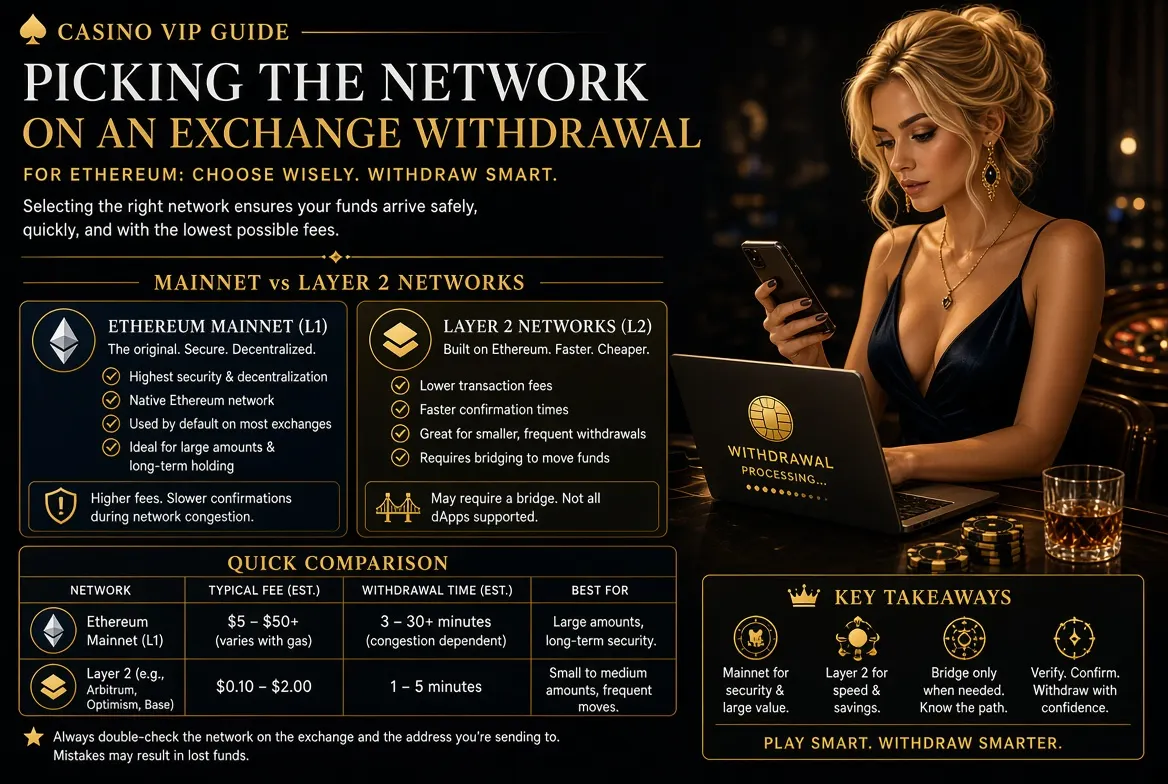
Layer 2 networks, often called rollups, process transactions away from Ethereum mainnet and post the results back to it. You get the same ETH with much lower fees, but it stays on that Layer 2 until you move it with a bridge. So before you add ETH to your wallet, decide where you want it to live, because that’s what the network dropdown is really asking.
| Network | Type | What fees feel like | Watch-out |
|---|---|---|---|
| Ethereum mainnet | Layer 1 | Varies with demand; can spike | Small transfers can be poor value |
| Base | Optimistic rollup | Usually very low | Receiver must support Base |
| Arbitrum One | Optimistic rollup | Usually very low | Moving back to mainnet takes longer |
| OP Mainnet | Optimistic rollup | Usually very low | Easily confused with other networks |
| ZKsync Era | ZK rollup | Low | Fewer platforms support it |
For context, Base, Arbitrum One and OP Mainnet were the three largest Layer 2s by value secured on the tracking site ETHBEAT (formerly L2BEAT) when I checked on 17 November 2026. Size isn’t the same as safety, though, and each network has its own upgrade and security arrangements.
Why Layer 2s Are So Much Cheaper
Rollups got a big boost from a run of Ethereum upgrades. Dencun, in March 2024, gave them a cheaper type of data space called blobs. Pectra, in May 2025, raised the number of blobs per block, and Fusaka, live since 3 December 2025, added a technique called PeerDAS that lets the network carry more blobs again. In ethereum.org’s words, the result is “more scale with smaller fees for layer 2s”. The next upgrade, Glamsterdam, is expected in late 2026, but no date has been confirmed.
Gas Fees Without the Jargon
Every action on Ethereum costs a fee called gas, and it’s always paid in ETH. You don’t need to master the maths, because your wallet suggests a fee automatically. Still, knowing what the numbers mean stops you overpaying or getting stuck with a transaction that won’t go through.
Base Fee, Priority Fee and Gwei
Gas measures how much work a transaction needs, and a plain ETH transfer uses 21,000 units. You pay for each unit in gwei, which is one-billionth of an ETH. The price has two parts: a base fee set by the network, which is burned, and a priority fee, or tip, that goes to the validator who includes your transaction. ethereum.org’s own example uses a 10 gwei base fee and a 2 gwei tip, giving 21,000 × 12 gwei, or 0.000252 ETH. Treat that as an illustration only, because real fees move with demand, and you pay even if a transaction fails.
Always Keep a Little ETH Back
⛽ This is the habit that saves the most frustration. Sending ETH, moving tokens or using any app on Ethereum all need ETH for gas, so a wallet holding only tokens is effectively frozen. On a Layer 2, you pay gas in that network’s ETH, not mainnet ETH. If you also hold tokens such as USDT on Ethereum, our USDT guide explains the same trap from the token side.
Step by Step: Withdrawing ETH to Your Own Wallet
Here’s how to add ETH to your wallet from an exchange in practice. It takes a few minutes, and every step is about making sure the network and the address match. Go slowly the first time and it’ll be second nature after that.
- Check which networks your exchange offers for ETH withdrawals.
- In your wallet, select or add the same network.
- Copy your 0x address; hardware wallet users should verify it on the device.
- On the exchange, choose Withdraw, then ETH, then the network.
- Paste the address and compare it in full, capitals included.
- Answer any questions about who owns the destination wallet.
- Withdraw a token amount first, track it on the matching explorer, then move the balance.
✅ Good news for a change: unlike some coins, ETH sent to your own wallet doesn’t need a memo or tag. If a form insists on one, stop and double-check you’re on the right page.
Sent ETH on the Wrong Network? What Happens Next
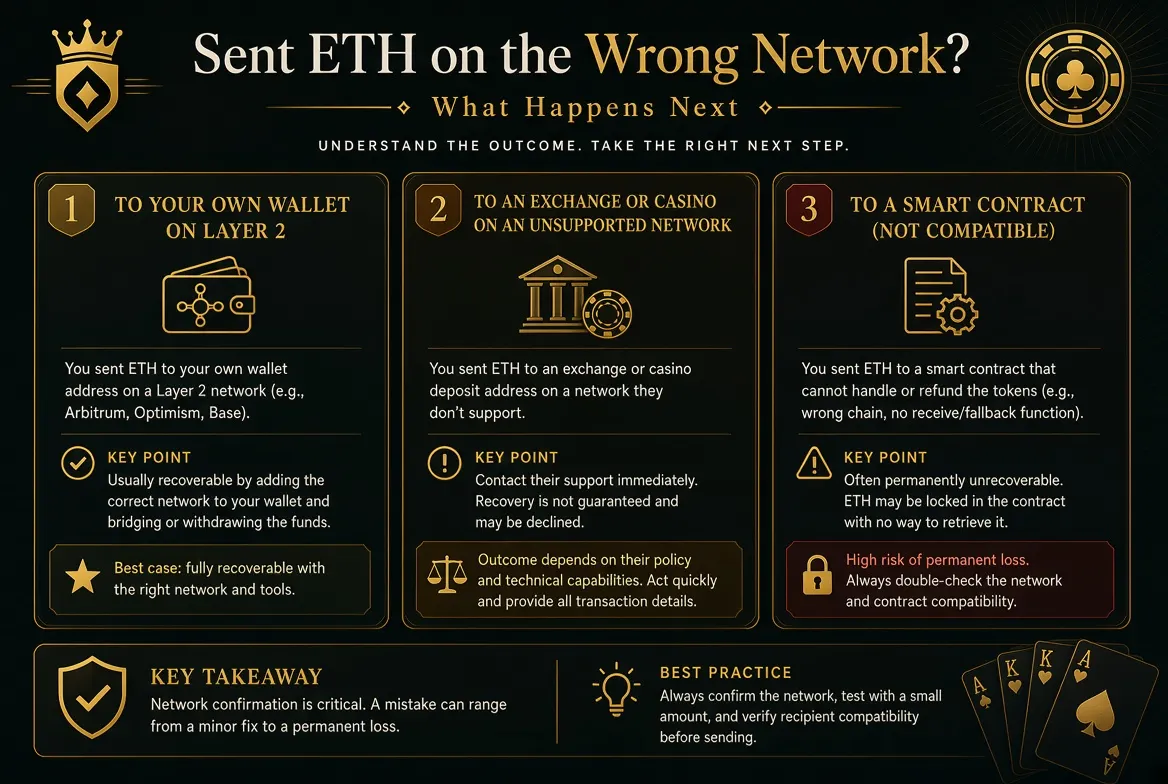
First, don’t panic, because the outcome depends on where the coins went. Ethereum’s shared address format means some mistakes are perfectly fixable, while others aren’t. ethereum.org is blunt about the baseline: “A transaction sent on Ethereum is irreversible.”
ETH Look-Alikes: WETH, Staked ETH and Fake Tokens
Open an Ethereum wallet for long enough and you’ll see tokens that look a lot like ETH. Some are legitimate tools, some are financial products with their own risks, and some are outright bait. Knowing which is which keeps you out of trouble.
WETH: Wrapped, Not Different
Wrapped ether, or WETH, is ETH placed in a smart contract that issues an equal amount of a standard ERC-20 token. Apps use it because many of them only handle ERC-20 tokens, and you can swap it back one-for-one. The catch is that WETH can’t pay for gas. As ethereum.org puts it: “You will still need native ETH to pay for gas fees, so make sure you save some when depositing.” Other versions of WETH exist on other chains, so check which one you’re holding.
Staked ETH and Liquid Staking Tokens
Staking means locking ETH to help secure the network in return for rewards. HMRC’s own manual describes the flip side: validators who misbehave or fail can have part of their stake destroyed, a penalty called slashing. Liquid staking tokens represent staked ETH and can be traded, but their market price can drift away from ETH’s. Holding one isn’t the same as holding ETH in your wallet, and the tax position can differ too.
Fake Tokens and Address Poisoning
Anyone can create a token and call it “ETH”, and scammers regularly drop junk tokens into wallets to lure you to a website. Don’t try to sell, claim or “unlock” tokens you didn’t buy, because those sites are often built to drain your wallet. Scammers also send tiny transactions from lookalike addresses, hoping you’ll copy theirs from your history later. Always take addresses from the source, never from past transactions.
Approvals, Drainers and Signing Safely
On Ethereum, you don’t only send coins; you also sign permissions. An approval lets a smart contract move your tokens later, sometimes without limit, and that’s how most wallet drains happen. ethereum.org’s advice is clear: “do not allow unlimited spend limits. An unlimited spend could enable the smart contract to drain your wallet.”
- Check the website address before you connect your wallet.
- Read what you’re signing, and reject anything you don’t understand.
- Set a specific spend limit instead of “unlimited”.
- Revoke old approvals you no longer need in your wallet’s permissions view.
- Ignore anyone asking you to “upgrade” or “migrate” your ETH.
- Keep savings in a separate wallet from the one you use with apps or casinos.
⚠️ On the upgrade point, ethereum.org says “anyone instructing you to ‘upgrade’ your ETH is trying to scam you.” Since Pectra, ordinary addresses can also opt into smart-account features, so only authorise that kind of request from wallet software you already trust.
UK Rules and Tax for ETH
Most UK rules treat ETH exactly like any other cryptoasset. The interesting differences are in tax, especially if you stake. Here’s the short version, with links for the general detail.
The Rules in Brief
Stick to platforms that appear on the FCA’s crypto register; onboarding means ID checks, a risk quiz and a pause before your first buy. Bank payment limits and the questions exchanges ask about withdrawals are explained in our bitcoin guide. When the FCA’s full regime begins on 25 October 2027, staking services are set to fall under it as well.
HMRC: Disposals and Staking Rewards
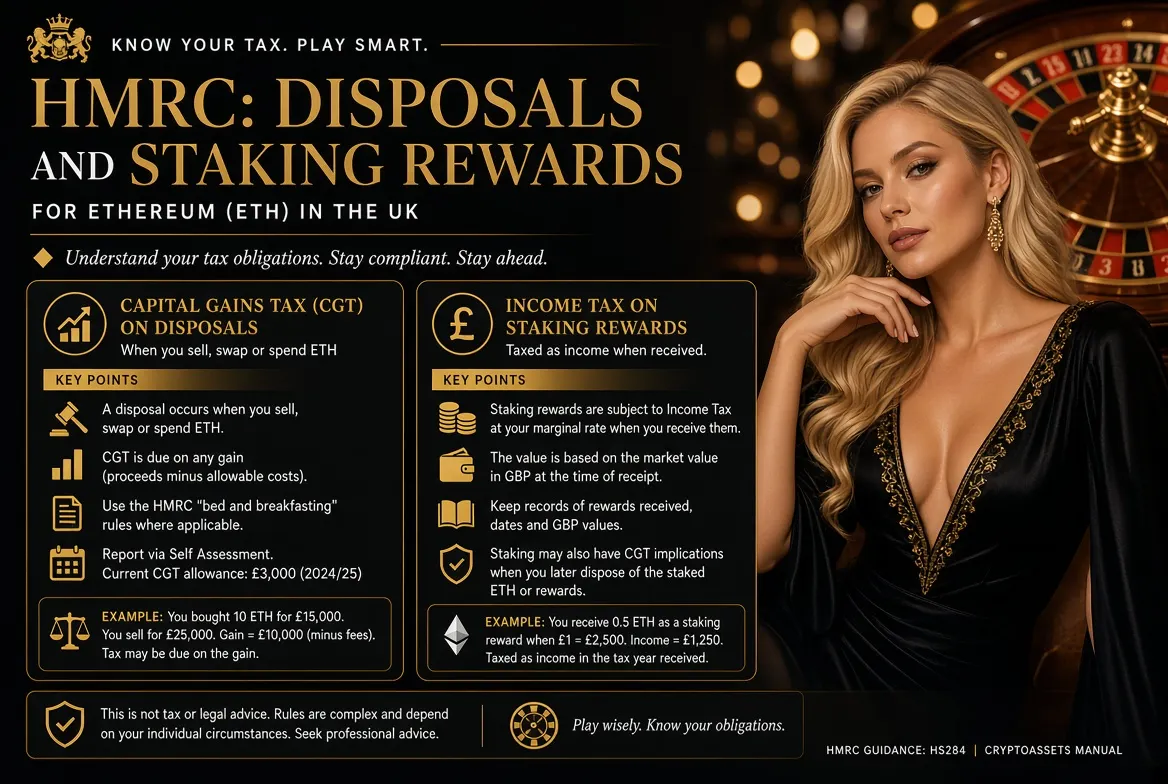
A £1,000 allowance covers trading and miscellaneous income each tax year. If your total from all sources is between £1,000 and £2,500 you should contact HMRC, and above £2,500 you need to register for Self Assessment. Selling the rewards later is a separate capital gains event. From 6 April 2027, new “no gain, no loss” rules will apply to certain crypto lending arrangements, but whether wrapping, liquid staking or a particular staking setup qualifies is exactly the kind of question to put to a tax adviser.
Using ETH for Crypto Casino Deposits
Plenty of readers want ETH for crypto casinos, so let’s be honest about the landscape. GB-licensed casinos don’t offer crypto deposits in practice, and the Gambling Commission has said it doesn’t expect that to change before the FCA’s regime arrives in 2027. Casinos accepting ETH from UK players are offshore operators, with weaker protection if a dispute arises.
The ETH-specific trap is the network: a casino cashier will say whether it wants mainnet ETH or ETH on a particular Layer 2, and you must match it. Mainnet gas can also make small deposits poor value. Our walkthrough on crypto deposits at no ID casinos covers the cashier, it’s worth asking are no verification casinos safe before you start, and keep our help page handy in case an account is locked for verification mid-withdrawal.
Before you play. Online gambling is strictly 18+. Decide on a spending limit you’re comfortable losing, and walk away once it’s gone. If you’ve self-excluded through GamStop, keep that promise to yourself and don’t go looking for workarounds. GamCare’s National Gambling Helpline offers free, confidential support around the clock on 0808 8020 133; you’ll also find live chat at gamcare.org.uk.
Final Thoughts
Ethereum rewards a little patience. Learn the difference between ETH and the network, choose mainnet or a Layer 2 on purpose, keep some ETH for gas and treat every signature with suspicion. Get those right each time you add Ethereum to your wallet and you’ll avoid the mistakes that catch most newcomers. For the bigger picture, our no KYC gambling guide is a good next read.
FAQ
These are the Ethereum questions readers send me most. The answers are deliberately short, and the sections above go deeper.
Is my ETH address the same on Arbitrum, Base and Ethereum?
For an ordinary wallet account, yes, the same 0x address works across them. Smart-contract wallets can differ, so check before receiving on a new network.
Which network should I withdraw ETH on?
Use one that both your wallet and the receiver support. Mainnet is simplest for savings, while a Layer 2 suits small amounts you’ll spend.
Why do I need ETH to send tokens?
Every transaction on Ethereum and its Layer 2s pays gas in ETH. Without some ETH, your tokens can’t move.
Is WETH the same as ETH?
It’s worth the same and can be swapped back one-for-one. However, it’s a token, so it can’t pay gas fees.
Are ETH staking rewards taxed in the UK?
Usually, yes. HMRC treats them as miscellaneous income valued in pounds when you receive them, and selling them later can trigger Capital Gains Tax.
How do I buy Ethereum in the UK?
Sign up with an FCA-registered platform, complete its checks and fund the account in sterling. Then add Ethereum to your wallet by withdrawing on the network you’ve chosen.